Tuesday, 26 November 2013

Annual Food Drive

New Leaf Annual Food Drive

This year we are experiencing a very cold winter season! So not only would we like to collect food for the Abbotsford Food Bank and Christmas Bureau, we would like to collect warm outerwear and blankets for the local shelters. 

Please help feed those in poverty, desperation, and in serious need of help. 

'Tis the season to spread joy and care for those in need.  Not all families are able to provide food, shelter and clothing to their loved ones.  This is the least we can do to help our local community become stronger. 

Make the most of your giving this Christmas.


There are many ways to give joy to those in need. If you are unable to come in and drop off a donation, you may also phone, mail or donate money online directly to the Abbotsford Food Bank:

Phone: 604-859-5749 or 604-859-7681
Mail: 33914 Essendene Ave Abbotsford, BC V2S 2H8

Monday, 25 November 2013

Maximize Your Health Insurance

We want our clients to get the best of their extended health benefits, be it only $250 of coverage to unlimited.  
That being said, I would like to focus on the best ways to use your coverage.

HOW TO GET THE MOST OUT OF YOUR EXTENDED HEALTH BENEFITS PLANS


The common trend is to hoard all of the benefit amounts until the last 2-3 months of the calendar year, and then binge on appointments to take advantage of the coverage. Not only does this burden the schedule of appointments required for injured workers, and new ICBC claim patients, but it also requires the practitioners to throw themselves into overdrive.  Therapists extend their hours to accommodate the large influx in new and returning patients, all wanting to reap the benefits of their insurance coverage. .

Saving all of your benefits for the end of the year to cluster your appointments may feel nice, but you're not necessarily making the best choice for your body or your therapist.  The best choice is to spread out your coverage over the entire year.  Your body will respond positively to treatment when spread out evenly over the year, rather than sporadically increasing therapy full tilt over two months, stopping as soon as the new year begins. Following this rapid increase and decrease in therapy each year is quite detrimental to a treatment plan.

Your body needs balance.  Equally dividing your expenses and finding a treatment plan to match your coverage individually is the best way to maximize your benefits.  It is important to take care of your body all
year long, not just during the last quarter.  

There are also negative affects on one's physical status if treatment is suddenly decreased, or stopped altogether.  The body may relapse, and fall back into a negative state of imbalance. Posture may become poor, pain may increase, symptoms may return.  This cycle is not balanced, and when one returns to treatment, the therapy has to start from the beginning again to get back on track. 

Creating a balanced plan will be profitable both financially and physically.  When one has a well balanced treatment plan, there is less risk for injury, treatment relapse, and an increase in total well being.  Our mission at New Leaf Massage is to help you maintain whole body wellness and balance in mind, body and soul. 

Here at the clinic, we understand that aches and pains may get the best of us, and we rely on the clustered treatment to feel the most improvement.  But there is a difference in feeling the improvement, than sustaining improvement. Our job is to help you reach your wellness goals and maintain them.  We are here to help you get back on track, and to help you keep your plan active and balanced.

One of the best things I decided to do this year was divide up my coverage between 3 therapies.  I will see the chiropractor once a month, my massage therapist once ever 7 weeks, and acupuncture every 7 weeks, and NIS as needed. This allows me to have therapy on a regular basis without bombarding my body or the schedule at the year end. My well balanced plan has allowed me to recover from a recent  injury much quicker than anticipated. 

I have never felt better!  My aches and pains have subsided, and my body feels more balanced than ever!  I no longer stress about how I'm going to use all my coverage and fight for desirable appointments times during November and December.  My body is benefiting more now, because I have stretched my coverage over the year, rather then squeezign it all into two months.  I have maximized my extended health to get the most out of my coverage. It is also important to not use every last bit of the coverage, save a couple 'extra' for those desperate times, or for unplanned illness, injuries and emergencies

Our team of professionals are here to help you organize a treatment plan to fit your unique needs as well as help you to get the most our of your extended health benefits. 

Please do not hesitate to ask your therapist for assistance with developing a treatment plan to fit your lifestyle.  We want you to turn over a new leaf, and live life well!  In order to achieve this, balance is required.


Maximize your benefits, and see how well you will feel year round!

If you have any questions or want advice, you can contact me at reception on Mondays, Tuesdays, Thursdays and Fridays or by email at newleafwellness@shaw.ca


Yours in health,

Kerissa Moore
Front Office Manager,
Receptionist
604-850-2511

Monday, 18 November 2013

WELCOME TARA OTTOSEN, RMT

Exciting things are happening at New Leaf these days!!

First off, we'd like to start with introducing our newest member to join our wellness team!


TARA OTTOSEN, RMT


Growing up in an active lifestyle, Tara initially became aware of the benefits of massage therapy after sustaining injuries to her shoulder and leg in an accident.  She was so impressed by the benefits of massage therapy to her healing process that she decided to enroll at WCCMT.  There she discovered an inner passion to help others reach their own optimal health.

Tara understands the importance of building trust between therapist and client, and is committed to treating the root cause of symptoms as a primary goal, besides relieving discomfort.  She uses Myofacial Release (MFR) to help increase joint movement and improve posture alignment, as well as incorporating Active Release, Trigger Point Release and Swedish Massage into her treatments.

Tara has volunteered at sports events such as the Knee Knacker, and the GranFondo.  She is an outdoor enthusiast, and in her free time enjoys playing music, knitting, hiking, sailing and biking.

Tara's techniques include:


  • deep tissue
  • swedish
  • trigger point release
  • myofacial
  • muscle energy technique
  • active release

We are currently booking new patients with Tara as of TODAY!

Call now to book your appointment.  Her hours vary, but are as follows: 

Monday 2pm-6pm
Wednesday 10am-6pm
Thursday 2pm-6pm
Friday 2pm-6pm


Secondly, I'd like to ask you to keep posted....we have many new changes that will be announced soon!

Yours in health, 
Kerissa Moore
Front Office Manager & Receptionist


Monday, 7 October 2013

BREAST CANCER SOCIETY FUNDRAISER

As you may already know, October is national breast cancer awareness month.


To celebrate and support the beautiful and important women in our lives, we are raising money for the Breast Cancer Society!

Join us on October 16th, wear pink and spread the support!

Starting today, Monday October 7th through Wednesday, October 16th our clinic will be offering a chance for you to win some awesome prizes!!

Here's how it works:


$20.00 to buy a ball.  Each ball will either be blank or have a number on it.  The objective is to pull a numbered ball, as we will be drawing for the prizes on Wednesday, October 16th at 5:30 PM.


Now, for the good stuff....Here is a list of our prizes available thus far:


  • 4 - $25.00 gift card to Lou's Grill (One per person)
  • Pink Breast Cancer water bottle ($15.00 value)
  • 60 minute massage gift certificate with Lisa Fershau, RMT ($95.00 value!)
  • 1 free session with Dr. Nagra for chiropractic treatment (up to $60.00 value!)
  • Purple Acu-Massage bar ($35.00 value)
  • J. Lohr 1 litre Cabernet Sauvignon ($25.00 value)
  • Daisy Canvas by Morris Rowley Photography ($100.00 value)
  • Booster Juice Eco Mug filled with goodies ($25.00 value)
  • Beauty kit ($25.00-$30.00 value)
  • Starbucks gift card ($10.00 value)
  • and many more prizes!!
Stay tuned as we update our list, we have some great prizes to be added!!

We look forward to reaching our goal of $1000.00


Tuesday, 27 August 2013

Definition of the Week: Range of Motion (ROM)

Why do we require initial appointments to be booked longer than subsequent appointments?

For massage therapy, our office policy requires an initial treatment to be booked for 45 minutes.  The following must be done by your RMT in your initial assessment:


  1. Obtain knowledge about your health history. 
  2. Assess any health risks contraindications.
  3. Assess and understand all of your past and current symptoms.
  4. Assess your range of motion.
  5. Your RMT will then decide if massage therapy is right for you.

What does it mean when your practitioner asks to check your range of motion (ROM)?


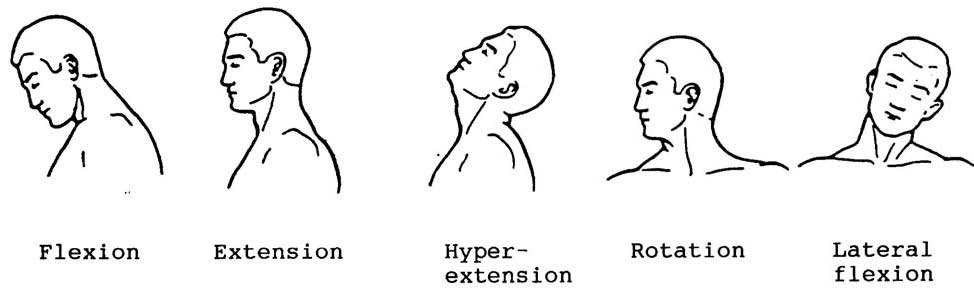
You therapists will assess the area associated with your symptoms.  Range of Motion will measure the flexion, extension, abduction, and rotation to compare to the average normal range.


For example, the most common complaint would be upper back, neck and shoulder pain.  The RMT will assess the degree of rotation (left and right lateral flexion) and extension, recording notes on the patient's file.  The ROM will be a degree achievable until restriction or pain occurs.  The human anatomy allows for the neck to reach a maximum degree without restriction and pain.  If the pain or restriction occurs before normal ROM, it would be noted and the therapist will treat the area to help increase and then maintain normal ROM.

The chiropractor would follow the same procedure, assessing even more in depth and the relation to the joints, bones and/or spine. A great example for chiropractic care would include a patient that is having trouble bending over.  The normal range of motion would allow for one to bend forward towards one's toes. However if there is a restriction because of tight muscles and a misaligned spine, this could be painful and outright impossible.  Using active release therapy and manual manipulation can greatly increase one's range of motion allowing a less painful bending ability in just one or two treatments!


What should you do if you are experiencing restricted or painful range of motion?


If the pain is excessive, please see your family doctor.  Find out if massage therapy, chiropractic care, or acupuncture could help you. Come in for an assessment and consultation.

Our chiropractor, Dr. Rav Nagra will provide a free consultation to discuss your symptoms and assess your ROM to determine if you need treatment.

What are the most important directions to follow when you experience decreased range of motion?


  • Seek professional health care advice and, or therapy.
  • Do your stretches!! We cannot stress this enough!
  • Keep moving, stay active.
  • Drink plenty of clear fluid. At least 64oz a day. (That means H20 my friends!)
  • Yoga and Pilates are great exercises that increase flexibility and ROM 
  • Stretch and strengthen. The stronger your muscles, the less "lazy" they will become.
  • Steam rooms, sauna, or heat packs to relieve sore, tight muscles.
  • Epsom salts baths can help too.


Another example:

See that the pink shaded area is the normal range of motion for both the foot and the knee


Helpful sites:
Kent Health Muscle Movement Chart & Useful information
Educational Neck Stretching Resource


Contact the clinic today if you have any other questions!

Keep active, drink water, and STRETCH. It feels good!
~Kerissa
Front Office Manager, Receptionist


Friday, 19 July 2013

Definition of the Week: Ergonomics


(Image from http://www.colebrookbossonsaunders.com/en-gb/ergonomics/background)

http://www.victoriamassagetherapy.ca/userfiles/image/Ergonomics.jpg

In simple words, Ergonomics is the philosophy and practice of proper posture, including the use of equipment.

Being a multidisciplinary wellness clinic, we treat numerous clients for back, neck and shoulder pain most commonly brought on by our jobs, including computer use and general tension from the use of work place equipment.  Awareness and correction are two main factors to regain a proper posture.  Having awareness about correct posture, and proper ergonomics is crucial to one's well being. If you are aware and remember to not slouch, your body can maintain pain free movement.  As one's body become lazy, the health effects can be quite detrimental.

If one sits at a computer desk for too long with ill posture, the anatomy is not able to work at it's optimal performance.  This will cause the body the compensate.  Muscle groups and tendons that are not normally used for this position will begin to strengthen.  Muscles that are normally used in a proper position will weaken, making it harder to regain a perfect posture. This cycle creates a sense of comfort in a poor position, rather than a strong proper posture.
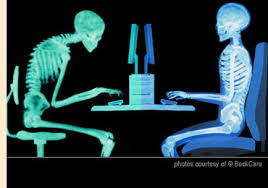
That is why we encourage our patient's to strengthen core muscles and practice perfect posture. (Or as close to it as possible.) It is important for our bodies to function at an optimal level for efficient results.

Imagine sitting at a computer desk with ill posture, for 8 hours a day, 5 days a week.  The body begins to feel comfortable slouching.  As the head tilts forward, neck and upper back muscles will begin to strain to hold one's posture.  Shoulder muscles will begin to round forward, putting increased stress on the mid to low back.  As all of these muscles become 'comfortable' in the slouching position, it is more difficult to bring the muscles and joints back into a natural position.

Another great example would be an employee operating heavy duty machinery, a mechanic, a welder, or really any trade worker....will require one's body to be twisted or maneuvered in a way that is not natural.  It is important to remember to stretch, and be aware of these uncomfortable positions so that the anatomy can be brought back to a natural, posture for pain free movement.  If the worker is able to practice safe ergonomics, the body will be much less affected.

There are many symptoms created by poor posture. Range of motion is most affected by poor posture.  Common symptoms associated with poor ergonomics are headaches, numbness and tingling, fatigue, back neck and/or shoulder pain, restricted range of motion and other aches and pains. Once the body becomes comfortable in  lazy position, range of motion significantly decreases.  This makes it difficult to produce quality work, and requires more energy than one with pain free, full range of motion.

Consult your employer or healthcare practitioner now to determine if you are using correct posture at work, or if you need help correcting your posture.  If you are experiencing any of these symptoms, contact our clinic to be assessed.  One of our qualified health care practitioners is waiting to help you practice safe ergonomics, and decrease the pain and other symptoms often associated with poor posture.

Safe practicing!

-Kerissa


Check out these images below to see the effects of poor posture over time:


Friday, 28 June 2013

Definition of the week : Fibromyalgia

  1. fi·bro·my·al·gia  

    /ˌfībrōmīˈalj(ē)ə/
    Noun
    A chronic disorder characterized by widespread musculoskeletal pain, fatigue, and tenderness in localized areas.


    Fibromyalgia is a neurosensory disorder characterized by widespread muscle pain, joint stiffness, and fatigue. The condition is chronic (ongoing), but pain comes and goes and moves about the body. The disorder is often misdiagnosed or unrecognized and is and often complicated by mood and anxiety disorders.


  2. Diagnosis


    There are no specific laboratory tests to diagnosis fibromyalgia. Diagnosis is difficult and frequently missed because symptoms are vague and generalized. Tests will be done to rule out other conditions with similar symptoms before a diagnosis is made. Coexisting disorders such as rheumatoid arthritis, systemic lupus erythematosus, or Lyme disease may further complicate the diagnostic process.
    In 1990, the America College of Rheumatology developed standards for the diagnosis of fibromyalgia. According to these standards, a person can be diagnosed with fibromyalgia if he or she has widespread pain in combination with tenderness in at least 11 of the 18 sites known as trigger points. Trigger point sites include the base of the neck, along the backbone, in front of the hip and elbow, and at the rear of the knee and shoulder. These standards have been criticized by some physicians as being too narrow for use in clinical practice. As of 2009, standards for diagnosis were under review.


    Alternative treatment


    Frustrated with the inability of conventional medicine to cure their pain, as many as 80% of individuals with fibromyalgia turn to alternative and complementary treatments to supplement conventional treatment. Common complementary therapies for fibromyalgia include:


    • acupuncture

    • biofeedback

    • chiropractic care

    • hypnosis

    • magnesium supplements

    • magnet therapy

    • massage therapy

    • s-adenosyl-L-methionine supplements

Friday, 21 June 2013

Definition of the week: Qi

qi   noun "

CHē" or "chee"

What is Qi?

QI is the energy whose properties are the basis and fundamentals of Traditional Chinese Medicine (TCM).  Qi flows through the body, it is all around us, and is believed to be two portions. Energy and changes in environment, and also physiological components of anatomy.

"Qi was initially termed as the best definition for the understanding of the natural phenomena." [1] Over 3,000 years ago, the alternative therapy described as acupuncture developed in China.  Acupuncture therapy is used to to stabilize and stimulate the body's Qi and immune systems to result in a permanent healing.  Qi is the vital energy or power that animated and supports the functions of the body. "In TCM, Qi has more meanings, Qi can move in the meridians, and can also combine with blood to support the energy to the internal organs." [2]

Ancient theory is that Qi flows through specific pathways, calls meridians, and provides nourishment for the entire body. The acupuncture meridian system is an interface of energetic exchange  between our physical body and the energy fields which surround us.

Acupuncture points have unique electrical characteristics which distinguish them from surrounding skin, and also mediated by a primary, subtle energetic system that influences the networks of physical nerves.  Stimulation of acupuncture points produce changes in the nervous system (ie. endorphin release and relieve pain) because the meridians indirectly influence nerve pathway in the body.  This treatment replaces pain and fatigue with revitalizing energy and relief of stress and tension.  As the Qi is 're-engerized' by the needles, the movement throughout the body is significant in the corresponding body systems (ie. liver, kidney, heart, lung. etc.) to produce outstanding results.

Because Qi is an energy, it may be affected by numerous factors.  Everything must be in balance for optimal performance and wellness.  Factors such as environmental, physiological and psychological can impede on one's energy and one's self balance.  When disease occurs, it is a signal that we are constricting the natural flow of life energy throughout our multidimensional bodies.  Once we have learned the real reasons for feeling ill, we must begin to make changes that will result in a healing on many simultaneous levels.

Traditional Chinese Medicine theories and treatments go far beyond treating symptoms and signs, treating the body as a whole and unique organism.  Acupuncture can greatly enhance our health and achieve better levels of wellness and integration and balance of the interlocking elements of the body, mind, and spirit.


References:

Friday, 14 June 2013

Definition of the week: Fascia

fas·ci·a  noun  

ˈfaSH(ē)ə

Fascia is a sheet or band of fibrous connective tissue that surrounds, separates, and/or binds together muscles, organs, blood vessels, nerves and other soft structures of the body.  It is the soft tissue components of the connective tissue the provide support and protection.

You may here your therapists use the term myofascia work or myofacial release.  The therapist may be referring to a soft tissue manipulation, or trigger point therapy.  Approaches may range from passive or active release therapy (ART), Graston therapy, stripping, foam rolling, or other tools and techniques may be applied both directly and indirectly


Fasciitis is a term most commonly associated with fascia.  Fasciitis is the inflammation of the fascia, connective tissue. This inflammation can be very painful.  Many patients prefer to have deep tissue work to directly  release the tension in the fascia.  A therapist may use tools to help stretch the adhesive tissues to mobilize them.  Our therapists will use their hands, knuckles and elbows to stretch the inflamed tissues with a pressure that is comfortable for you.

An indirect approach will be used for patient's that cannot handle or do not like deep pressure.  This approach would include ART, and gentle stretching to help mobilize the fascia.  The release may affect the muscles surrounding it, causing a sense of relief for the patient, sometimes allowing a deeper massage for the latter treatment.


"Like ligamentsaponeuroses, and tendons, fasciae are dense regular connective tissues, containing closely packed bundles of collagen fibers oriented in a wavy pattern parallel to the direction of pull. Fasciae are consequently flexible structures able to resist great unidirectional tension forces until the wavy pattern of fibers has been straightened out by the pulling force. These collagen fibers are produced by the fibroblasts located within the fascia.
Fasciae are similar to ligaments and tendons as they are all made of collagen except that ligaments join one bone to another bone, tendons join muscle to bone and fasciae surround muscles or other structures."
-Wikipedia


FASCIAL MOBILIZATIONThe fascial system is one continuous, laminated, connective-tissue sheath that spreads without interruption throughout the entire body in a three-dimensional web. Fascial mobilization allows therapists to locate and address restrictions in the fascial system that are causing asymmetries, postural malalignment, abnormal tensions, and pressures that can lead to pain and dysfunction. The goal of fascial mobilization is to produce a well-balanced, symmetrical, and mobile body within the skeletal, soft-tissue, and craniosacral systems.


References:
http://www.massagetherapy.com/glossary/

Monday, 10 June 2013

Friendly Reminder--Office Policies

As we approach the summer season, we understand that life gets busy.  Please take us into consideration when planning your vacation and seasonal holidays.

If you have any appointments booked that you may need to cancel or reschedule, please give us ample notice.  24 hours noticed is required for all cancellations and rescheduled appointments.  Your appointment time has been reserved for you.  Any late cancellations or missed appointments will result in a fee.


Late cancellations will be charged 50% of the appointment fee.  If notice is less than 1 hour before your scheduled appointment time, you will be charged the full rate.  All missed appointments will be charged the full appointment fee.

Unfortunately, due to increased missed appointments and last minute cancellations, our policy will be strictly enforced.  However, do not hesitate to speak with reception or your therapist if you have any concerns.

Our clinic is booking well in advance and if you cannot make it to your appointment, there are a large number or client's on our cancellation list that would love amply notice for booking.


We appreciate your cooperation in this matter.  Thank you for respecting our policy!

-New Leaf Wellness Staff